




 Loading.....
Globalization is Eroding the Government’s Power from an Economic Perspective
Multiple factors are influencing the gradual emergence of a global economy in the 21st century
By: Exequiel Octavio Bertaina, Online Editor
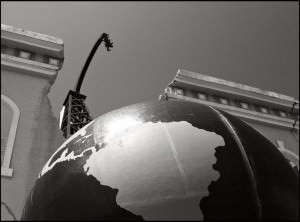
Globalization in the contemporary world of politics has taken a particularly powerful form in recent decades, as innovations in communication, transportation, commerce and information technologies continue to generate new challenges to the dominance of a government over its economy. Even though the term globalization has existed for quite some time, it’s the intensity and scope of worldwide integration it has brought forward in the past two decades which makes this issue much more appealing. Without any signs of deceleration, these global forces keep transforming the social and economic landscapes in our societies. What’s alarming is that globalization has posed fundamental challenges to the traditional assumptions of economic and social equality, which clearly have weakened a government’s dominance and role within its borders.
A distinguishing feature of globalization is the emergence of supranational decision-making bodies such as the International Monetary Fund (IMF), the World Trade Organization (WTO) and the World Bank. These have become the most important institutions in economic affairs. The growing mobility of capital and free trade promote these supranational decision making organizations which, in return, reduce the control governments have over their economies. Undoubtedly, all of these factors put together have created greater social and economic inequalities due to the new realities of the market “laissez-faire” approach.
These organizations can be considered as shifting the role of the political authority from nation-states to global financial organizations. The government authorities are constrained by these supranational institutions as they heavily influence monetary and fiscal policy on a micro and macroeconomic level. Also, members of these organizations are required to abide by the rules and regulations governing international trade, which forces the governments to enact macro-decision based rules and guidelines imposed by these international organisations. It’s no secret that these governments are required to alter their convictions or procedures in order to satisfy the worldwide trade laws.
Hence, globalization is slowly accelerating the emergence of a single global economy and the power of a single government is undoubtedly diminishing (think of the United States and its diminishing influence). Interestingly, the state’s scope of action in these areas cannot solely be tamed by monetary or fiscal policies, as the global-market forces control most of the fundamental fluctuations such as the exchange rates (excluding to a certain extend the United States of America).
[pullquote]
… this process no longer unfolds within the geographic conception of where Army Men fought wars to nationalize those same territories centuries ago
[/pullquote]
Another aspect of globalization is the growing mobility of capital and the relative immobility of labour. If taxes, unwelcoming industrial policies, stiff environmental regulations are too costly or constraining, investors will pull up all stakes and transfer them elsewhere even if workers cannot move so easily. As John Gray points out: “global spreading of industrial production and new technologies encourag[es] unbridled capital mobility and unlimited trade liberty”. Therefore, the expected results of limiting taxation on producers will have to be shouldered by the labourers.
It also ties the hands of the political forces, even those whose ideological traditions support state intervention in production and redistribution. In this view, it hardly matters whether the left or the right is in power, as the restraints of the internationalized economy will oblige the ruling party to follow the same monetary and fiscal policies or else face a loss of national competitiveness and potential foreign investor opportunities.
One does not need to look through the lenses of international trade theories to see links between globalization and the shrinking of a country’s control over their economy. One of the deepest sources of concerns about financial market laissez-faire is whether the race to the bottom in wages jeopardizes old opportunities to be relocated at lower production cost countries.
Ultimately, the government’s fiscal policy is indirectly constrained by capital mobility, since taxes cannot be raised without negatively affecting the competitive advantage of its domestic producers. The likely outcomes of nation-states trying to avoid budgetary crisis by increasing taxes could lead to higher unemployment due to the intricacies of the global economy.
Undeniably, this is one of the principal sources of pressure that have forced cuts in social spending instead of increasing government revenue by the mean of taxation.
Interestingly, the primary political values required by the business markets are order, tranquility and freedom of free trade. None of these criteria invoke the need of citizenship, social justice or equality, which are necessarily promoted by the nation state. One much-noted reality is that firms can now operate across multiple borders with ease since that’s what the economic phenomenon of globalization is all about.
The growing numbers of economic activities are taking place in digital spaces since they override all existing territorial jurisdiction and operate under international market trade guidelines. Further, this growing virtualization of economic activity in the financial field amplifies the crisis of losing control of the country’s macroeconomic sovereignty.
What should not come as a surprise is that this process no longer unfolds within the geographic conception of where Army Men fought wars to nationalize those same territories centuries ago.
The decline of a country’s authority to act in many areas of life has led to the re-emergence of civil societies, which are gradually becoming significant players in the global governance. Global civil society is comprised of a broad range of organizations and associations from advocacy groups to trade unions and professional associations.


















Share the post "Globalization is Eroding the Government’s Power from an Economic Perspective"