




 Loading.....
Profiting vs. Profiteering
Via Hermes-Press.com
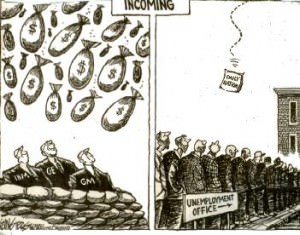
The Bush administration’s primary goal in entering Iraq was to gain control of Iraq’s oil fields. In order to accomplish this objective, the United States had to overthrow the opposing Saddam Hussein regime, as well as form alliances with the local militias in Iraq who were hostile to other militias against the U.S. insurgency. As Woof explains, “The Bush administration wanted an effective ‘puppet government’ in Iraq, which allows the U.S. to run the show.” As a result of this, the American government then helped form contracts with large, mostly American companies, enabling these companies to profiteer from the Iraq War.
Unfortunately, profiteering from war is only a subset of the problem. Profiteering from devastated countries hit by earthquakes, floods, tsunamis, hurricanes and so on is also prevalent in the contemporary world. In the past months, floods have caused severe damage and casualties in Sri Lanka, Australia, Brazil, and Pakistan. In the past several years, there have been various catastrophes such as the Haiti Earthquake in 2010, Hurricane Katrina in 2005 and even the 2004 Indian Ocean earthquake and tsunami.
//
//
With various natural disasters happening from month to month and from year to year, it provides companies the opportunity to profit from the distress faced by the casualty nations of such disasters. One such example is the profiteering activities by corporations after Hurricane Katrina. A review of documents related to contracts given out post-Hurricane Katrina by Gulf Coast Reconstruction Watch reveals that there was a total of at least $136.7 million in corporate fraud. Bechtel, who profiteered in the Iraq War, received a contract worth $575 million for construction.
Similarly, AshBritt received a $500 million contract, Fluor obtained a $1.4 billion contract, and the Shaw Group was awarded a large contract worth $950 million. These entities profiteered from these multi-million dollar contracts after Hurricane Katrina. Some of the contractors failed to meet their obligations and charged the government for work that was never performed or fulfilled because of the lack of oversight. A recent report from the Disaster Accountability Project (DAP) explains that many relief organizations have left donations, obtained for the Haiti earthquake reconstruction, in their bank accounts, earning interest rather than helping the people in Haiti. One of the roots of this profiteering is the significant lack of transparency, once again.
[pullquote]Many relief organizations have left donations, obtained for the Haiti earthquake reconstruction, in their bank accounts, earning interest rather than helping the people in Haiti.[/pullquote]
As mentioned earlier, credit card companies like MasterCard and Visa are using the earthquake in Haiti to profiteer. About 97 percent of donations, when paid through credit cards, will truly make it to the selected organizations – but the remaining 3 percent will be pocketed by banks and credit card companies to cover their “transaction costs”. American banks and credit companies were able to make enormous profits of $250 million thanks to this hidden fee. Credit card companies rarely waive these fees in times of crisis. Not-for-profit companies do not question these credit card companies as it’s a crucial service to them as well as the huge amount of money at stake.
To this point, everything discussed revolved around companies profiteering—benefiting immorally and unethically—from wars and natural disasters. But, is it fair to generalize that all companies gaining from wars and disasters are doing so unethically? Not so.
Woof clarifies that there are three ways to gain from wars and devastations: “The legitimate and ethical way to profit from wars is supplying medical supplies and equipment, which you need in any kind of a disaster. The neutral way to profit is when a supply of a product is reduced because of a disaster in a country. This allows other suppliers in the different countries to raise the price for the product. This is inadvertently profiteering, as they do have to raise the price because of a decrease in overall supply. The negative way to profit – profiteering – is where companies produce and provide munitions and weapons.”
[pullquote]“The legitimate and ethical way to profit from wars is supplying medical supplies and equipment, which you need in any kind of a disaster.”[/pullquote]
An example of a company that had benefited ethically from a disaster was Wal-Mart. Wal-Mart helped the people displaced or affected by Hurricane Katrina by providing clean water before even the government was able to assist. Like Wal-Mart, many other multinational corporations are trying to maintain and gain a better corporate image and focus on corporate social responsibility. However, not all companies look to gain from wars and devastation ethically; several companies profiteer from these devastated regions.
In recent times, profiteering from wars and devastation has grown in prominence. But what will happen to these industries and companies that profiteer from wars and disasters in the future? Will they proliferate or diminish? As long as natural disasters and wars keep occurring, these companies and industries should realistically continue to flourish.
“In the future, certainly, we are going to get more climate disasters related to global warming as it’s becoming a growing issue. A lot of these corporations are going to look to get into these disaster-hit areas to provide food and water at exorbitant prices,” Woof remarks. At the other end of the spectrum, corporate social responsibility is also becoming increasingly important to businesses.
But this begs the question: can the general public differentiate between the two? And, are we making it too easy for some companies to exploit CSR for profiteering purposes? Regardless of your personal conclusions, we can no longer play the bystander role.
ARB Team
Arbitrage Magazine
Business News with BITE.
Liked this post? Why not buy the ARB team a beer? Just click an ad or donate below (thank you!)
Liked this article? Hated it? Comment below and share your opinions with other ARB readers!


















Share the post "Profiting vs. Profiteering"