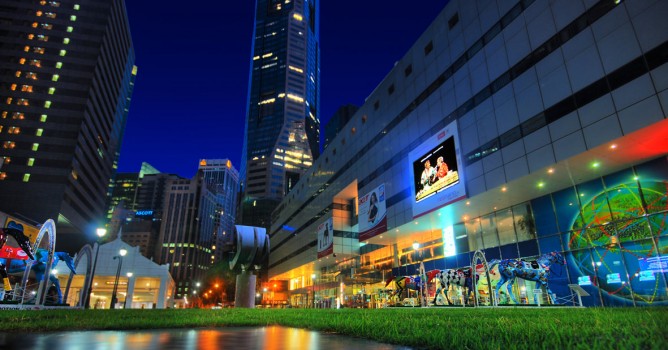

Singapore: A Future Economic Powerhouse?

August 14, 2012 8:00 am

How Singapore blossomed into a world-class economic example

Written by Exequiel Octavio Bertaina, Staff Writer

Williamcho (Flickr)

http://www.flickr.com/photos/adforce1/

On 5 August 1965, after enduring two years of intense friction with the Malayan central government in Kuala Lumpur, Singapore declared its independence to become the Republic of Singapore. Singapore chose to maintain a certain social and cultural distance from its neighbouring countries, while deliberately developing a new and distinctively ‘Singaporean’ culture and social identity. By late 1989, though physically small, Singapore was an economic giant. It is a multicultural, modernized and orderly country, with its major cities populated by a mosaic of individuals hailing from Chinese, Arab, Malaya, Indian and English backgrounds.

Economic Reform

The components that propelled Singapore’s success were comprised of major reforms in every aspect of the country. The central government was aware of the need to develop policies that would enable Singapore to attract investors and business, so it instated policies that would promote international trading and ensure economic development.

Education Reform

In 1979, the educational system was overhauled, with one of the primary goals being to decrease the dropout rate and to help those with low academic performances leave school with some marketable skills. The schools now operate on a modified British-style system in which the main qualifications are equivalent to the Cambridge University General Common Entrance Examination levels. The primary language of instruction in schools is English, while varieties of distinctive dialects (of Chinese, Indian and Malaysian background) hold primacy at home, where traditional practices and language customs are still prominent.

In 1987, Singapore’s school system saw further reform when 4 percent of the gross domestic product (GDP) was devoted to education, but the government’s goal for the 1990’s was to increase spending to 6 percent of their GDP, which would match the levels of Japan and the United States. While education was not obligatory in Singapore, records suggest that attendance is nearly universal. Primary education is free and citizens receive free education until they reached university. There were special funds available to ensure that no student dropped out because of financial need and they even created a system of loans, bursaries and scholarships for superior academic performance.

Industrial Legacy

When Singapore separated from Malaysia, the Singaporean industrial sector was miniscule. In 1960, it was a mere 11.4 percent of the GDP and commerce was by far the largest sector, which accounted for 32 percent of the GDP. In 1959, the country began implementing new policies to promote industrialization. Singapore adopted several new import/export policies, including the 1967 “Proclamation of the Export Expansion Incentives Act” and the 1968 “Employment Act”.

These policies ensured that direct foreign investment was viable, allowing Singapore to become a serious contender on the international market. Throughout the 1970’s various programs were implemented in order to encourage the growing industrial structure and to accelerate the country towards higher skilled, more technology driven and higher valued economic activities.

Technological Development

Back by government encouragement in the 1970’s, Singapore’s technological industry began a calculated transition away from labour-intensive products and towards the development of more technologically advanced production facilities. The National Computer Board was created in 1981 to help establish Singapore as an international center for computer services. In addition, it reduced the shortage of trained computer professionals and assured that high-tech professionals trained in Singapore had skills that were competitive on the international job market.

In order to ensure the continued health of the technological sector, the Singapore parliament passed its first copyright law in 1986, to restrict the manufacturing and selling of black market goods. Laws such as this were important in order to avoid trade sanctions by the western markets. Such measures also ensured that international computer and software companies would continue to do business with companies based in Singapore.

Manufacturing

By 1988, the Singapore manufacturing sector was producing more economic returns than both the financial and business sectors. A large component of the success of the manufacturing sector lies in Singapore’s success endeavour to encourage foreign and international investment in Singapore-based companies. The manufacturing industry was increasingly in the forefront of technological innovation because of the Economic Development Board’s promotion of computer-controlled production, industrial robots and flexible manufacturing systems.

To a lesser degree, domestic enterprises also played a role in the continued industrial growth of Singapore. As the Singapore government believed that an emphasis on large international companies would effectively increase productivity and long-range economic development, major government-sponsored promotional efforts were put into practice, with a focus on higher productivity projects.

The Petroleum Factor

Petroleum and petrochemicals are among Singapore’s main industrial and economic sources of wealth. In the late 1980’s, Singapore was the world’s third largest oil-trading center and as the center for refining petroleum. Additionally, it was the second largest builder of drilling rigs. Their facilities for repairing and maintaining existing rigs and tankers were among the most competitive in Asia. In 1981, when oil prices began to fall, Singapore felt both negative and positive consequences.

The collapse of oil prices dealt a severe blow to oil exploration. The impact was felt widely and immediately in everything from reduced orders for rig construction to lowered occupancy of luxury apartments as foreign petroleum workers returned home. Their vulnerability was based on their heavy dependence towards outside markets. It lead to the leaders of Singapore in finding a way to buffer their country’s response to perturbations in the world markets and to take advantage of their country’s ability to respond to changing economic conditions.

Unable to control so much that affected their nation’s prosperity, they concentrated on those domestic institutions that could be controlled. The consequence was an economy characterized by a seemingly paradoxical adherence to free trade and free markets, in combination with a dominant government role in macroeconomic management and government control of major production enterprises.

Some of the additional benefits included the availability of cheaper energy and its refineries invested in equipment and technology necessary to enable them to refine a wide variety of crude oils to obtain a greater proportion of high valued products from the refining process. Petroleum refining alone made up 28 percent of Singapore’s manufacturing output in 1985, although by 1988, it had dropped by half because of a decline in petroleum production and growth in other industries. Singapore also benefited indirectly when large oil importers such as Japan and the United States obtained higher real incomes from lower oil prices, enabling them to increase their imports from Singapore and other countries.

In addition, the extraordinarily high domestic savings rate provided financial reserves, which enabled Singapore to weather economic storms such as trade recessions, and generated a pool of domestically controlled capital to serve the long-term interests of Singapore. However, as the high savings rate was the result of carefully formulated government programs, this included a compulsory contribution of up to 25 percent of all salaries to a government-controlled pension fund.

The government also operated a set of government-owned enterprises and held stock in additional domestic and foreign firms. Government leaders, deeply aware of Singapore’s need to sell its services in a competitive international market, continually stressed the necessity for the citizens to master high levels of skills and to lower their personal wishes for the good of the community. The combination of devotion to free-market principles and the need for internal control and discipline in order to adapt to the demands of markets ensured they would continue to process in the international markets.

Legacy

Developing countries should take notice that it takes time, patience, perseverance and determination to become a more important player in the global markets. Singapore clearly demonstrated this by gradually instating well thought reforms. Another key aspect is government intervention and regulation of the market and production sectors. The government clearly had a long-term objective, but adjusted its policies based on current realities.

During the oil price collapse, the Singapore government quickly realized that they needed to be less vulnerable to market shocks. Therefore, they reacted appropriately by instating reforms aiming towards the high-end manufacturing sector and higher-skilled labour markets. While the political atmosphere in Singapore has been criticised for its laissez faire approach to democracy, its political environment was a primary force in helping to stabilize the economy.

What other countries should also learn from Singapore is that political stability, high level of education, open-market policies, modernized infrastructures, attracting foreign investor policies and sustainable long-term economic objectives are key elements to ensure a country’s success in today’s competitive markets.

ARB Team
Arbitrage Magazine
Business News with BITE.

Liked this post? Why not buy the ARB team a beer? Just click an ad or donate below (thank you!)

Liked this article? Hated it? Comment below and share your opinions with other ARB readers!

Featured Posts

  • General CFIA Issues Salmonella Warning on Almond and Peanut Products

    CFIA Issues Salmonella Warning on Almond and Peanut Products

    Potentially contaminated products were sold across the country By Sarah Munn, staff writer The Canadian Food Inspection Agency (CFIA) has issued a consumer advisory warning of possible salmonella contamination in certain nut butter products. The recalled  items are certain almond butter, peanut butter and tahini products from Tootsi Impex Inc. The products have been sold across Canada at retailers in Alberta, British Columbia, New Brunswick, Nova Scotia, Ontario, Quebec and Saskatchewan. So far, there have been no reported illnesses. Salmonellaare [...]

    Read more →
  • Science & Technology Hadfield’s Star Rises High with Return to Earth

    Hadfield’s Star Rises High with Return to Earth

    Astronaut returns as the Canadian Space Agency faces challenges By: Sarah Hartwick, Staff Writer Canadian astronaut Chris Hadfield sang his goodbyes to the International Space Station on Sunday night with his own version of David Bowie’s Space Oddity. The video, created by Hadfield and his son Evan, features the astronaut portraying the fictional ‘Major Tom,’ singing and playing his guitar. Shots of his performance, as he floats “in a most peculiar way,” are interspersed with scenes of the Earth below. [...]

    Read more →
  • General Lifestyle Student Resources Trends ABC’s to Sticky Teaching

    ABC’s to Sticky Teaching

    Everyone has their own way of taking in new knowledge but, have you ever wonder if there is a golden trick of learning? This infographic will teach you the ABC’s of sticky teaching and explains what a brain cannot ignore when it comes to learning.

    Read more →
  • General Lifestyle Science & Technology Technology Trends The Rise of Silver Surfers

    The Rise of Silver Surfers

    When was the last time you saw grandma staying at home knitting? Take a second thought and you might realize that what she was holding on her hands were not the knitting yarn, but rather it was a smartphone or a tablet! Not only does the younger population spend time on the Internet, this Infographic shows the growing number of new-tech users to be those over the age of 50.

    Read more →
  • Business Canada Culture Finance & Economics General Spotlight Topics LCBO Strike Looms Over May Long Weekend

    LCBO Strike Looms Over May Long Weekend

    Customers have been encouraged to stock up as LCBO employees plan to walk off the job By Kevin Chao, staff writer Before you pick up party cups or invite friends over for drinks this long weekend, be sure to stock up on booze. LCBO workers are expected to go on strike this Friday, just before the Victoria Day weekend. Negotiations are currently taking place between the LCBO and the Ontario Public Service Employees Union (OPSEU), but reports suggest that a [...]

    Read more →
  • Business TTC Pedals towards a Merge with Bixi Toronto

    TTC Pedals towards a Merge with Bixi Toronto

    TTC’s Potential Merger with Bixi – a Questionable Move By Viviane Fairbank, Staff Writer Bixi Toronto’s financial troubles may soon be over as the TTC explores the possibility of a merge between the two public transit systems. Karen Stintz, chair of the TTC, told CP24 that she intends to “move a motion to request a review of whether the TTC could actually take over the BIXI portfolio” during a recent council meeting. Stintz reasons that an added component of Bixi [...]

    Read more →
  • Arb TV Why We Should Abolish Corporate Income Tax

    Why We Should Abolish Corporate Income Tax

    Economist Daniel Altman explains how the United States have a very complex tax system, where it takes hours for you to fill out your returns (one for each of your sources of income, filing state taxes separately, and even local taxes seperately if you have them). So, let’s get rid of corporate income tax! I mean, who pays it? People who have company shares? Or employees? If a company spends all of its income and has no profits, they don’t [...]

    Read more →
  • Arb TV Dressing Right For Interviews, Ladies Edition

    Dressing Right For Interviews, Ladies Edition

    A few tips can make a great first impression; dressing professionally and appropriately is key, whether you’re candidating for a CEO position or a McDonald’s Big Mac-maker. Let’s start at the top. Hair should be neat, tidy, and as close to your natural shade as possible. On the face, little makeup is required to look mature, but stay away from harsh, bright colours. Speaking of colours, paint your nails! If you don’t have the time, or are like me and [...]

    Read more →
  • Arb TV This Is How Advertisements Suck

    This Is How Advertisements Suck

    Advertisers care about everything: how old you are, how much money you make. They want you to slip into watching content but also, their ads–”lean back entertainment” especially of TV. But if you think about it, the TV shows right now that have the most community gathering are not on cable, and thus are not funded by advertisements. Exhibit A: Dr. Who. They don’t realize it’s not the amount of viewership who tune in every evening, it’s the commitment of the community. [...]

    Read more →
  • Technology The BlackBerry Q10 and R10

    The BlackBerry Q10 and R10

    BlackBerry is unveiling new smartphones: but will it be enough to save this fledgling company? By Aziel Goh, Staff Writer It’s no secret that BlackBerry’s (previously Research in Motion), previous dominance in the smart phone industry, has collapsed. They have experienced a drastic fall in market share and sales due to the increased competition from newer competitors – namely Apple and Android. However, BlackBerry has refused to bow out of the lucrative, and expanding, smartphone industry. Earlier this year, BlackBerry [...]

    Read more →