




 Loading.....
The Public Mind vs. Public Sector Unions
“Is the public mind correct in its ideological disjoining with American labor unions? A more important question might be, is it justified?”
Written by William Shaub, Online Editor
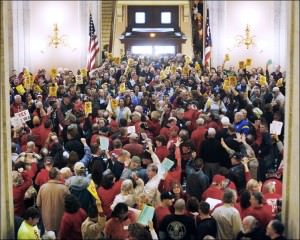 The common assumption made when one hears about a union going on strike is that the workers (union members) hold a proportionate or fair amount of power to what management holds in the workplace. Of course, that power may differ from the kind that owners, managers, shareholders and investors have, but the fact that workers can choose not to sell their labor for a period of time generally fuels the popular perception that the balance of power in the workplace is about 50-50.
It’s arguable whether or not the acceptance of this idea by the public should be ridiculed, but the supposition in itself is factually flawed and ideologically driven. Even if you leave out the ideological conditions in the workplace, such as the undemocratic hierarchical structure, the ‘wage slavery’ argument, or long periods of time obeying orders, there’s still mountains of evidence demonstrating that this notion is false.
For example, with the immobility of labor (a fundamental mistake of modern implementation of classical economics), workers are essentially forced to sell their labor to an institution and accept a general lack of entitlement to the rights normally enjoyed by other citizens to survive. This ‘lack of entitlement’ includes the absence of a fundamental rule of our legal system–the presumption of innocence. If management accuses a worker of a transgression, there is no such presumption. As the labor saying goes, “work first, grieve later”. Without unions or minimal federal support, there is not even protection against various arbitrary actions by management.
Free speech, a supposedly prized American value, does not extend to the workplace by law, or at least not to workers. In fact, management and owners are allowed free speech, but not workers. Elaine Bernard, Executive Director of Harvard’s Trade Union Program, explained it briefly in a 1998 article for New Party Paper 4 (Pamphlet Series):
“Because the Bill of Rights forbids only government, not “private,” restrictions on speech, it does not protect workers’ speech. Further tilting the balance of power against workers, the Supreme Court held that corporations are “persons” and therefore protected by the Bill of Rights. So any legislation (e.g., the National Labor Relations Act) or agency (e.g., the National Labor Relations Board) that seeks to restrict a corporate “person’s” freedom of speech, is unacceptable.”
The public needs to understand that when workers enter the workplace, a decidedly private institution, citizens are transformed into employees who must leave their rights at the door. However, Americans do not accept this, and instead acknowledge and favor the exact opposite; that workers are ‘on par’ with management in the 21st century.
[pullquote]Workers are essentially forced to sell their labor to an institution and accept a general lack of entitlement to the rights normally enjoyed by other citizens to survive[/pullquote]This is evidenced by a series of recent polls regarding the situation in Wisconsin. In a recent poll, Scott Rasmussen found that 48 percent of voters take Governor Scott Walker’s side in the ‘budget’ dispute while 38 percent support the unions. By a similar margin of 49 percent to 38 percent, voters question whether public-sector employees should even have the legal right to strike. According to a recent report issued by the PRC (Pew Research Center), “the favorability ratings for labor unions remain at nearly their lowest level [45 percent] in a quarter century.”
In fact, another recent Rasmussen poll found that even union workers are split on the issue. A plurality of 46 percent of workers favor their fellow unions in the public sector, but 44 percent support the Governor’s proposal to abolish public-sector collective bargaining.
There are several ways one could analyze the failure of American unions to win popular support over the past few decades, but it’s especially interesting that even support within their ranks has dwindled to current levels. Michael G. Franc, a columnist for the National Review, believes that most private-union members and pro-union voters who work in the private sector tend to distance themselves from class struggle when they feel over-taxed. He writes in his March 1st, 2011 column that they “see themselves primarily as stressed-out taxpayers, and therefore see things differently than their brethren in the public-sector unions.”
If what Franc writes is to be believed, then that would support the theory that unions have been gradually fragmented, most likely in many different ways, including from within. MIT Professor Noam Chomsky attributes this to several negative and opportunistic qualities that he believes are unique to American unions.
In an interview with Citizen Radio on May 13, 2009, Chomsky cites America’s current healthcare system as an example of the failure by American unions to establish a strong, formidable relationship with the public.
“Canada has a functioning national healthcare system. The United States is alone in the industrial world in that it doesn’t. Part of the reason for that is the difference in the ways the unions acted. If you go back to the initiation of the healthcare system in Canada, it came from the labor unions. Except, what they fought for is healthcare for everyone. The American unions fought for healthcare for themselves. So UAW (United Auto Workers) got a good social welfare package: healthcare, pension, stuff like that, for themselves. Not for anyone else…”
“The unions were willing to just trust management. Since we’re all in it together, you guys will take care of us. Well, you can see what happened. Management decides, “Sorry, game’s over.” They ended up with nothing. If they had worked for social welfare for everyone, it wouldn’t be a utopia, but at least there would be some functioning system for everyone.”
This theory, that American unions almost purposefully disconnected themselves from the general public over time, appears to be evident in the Rasmussen and Pew polls that were mentioned earlier. Ordinary citizens and even workers feel a social divide, and this has been routinely exploited by opponents of organized labor and union supporters. We’re seeing a special form of this exploitation by the state governments in Wisconsin, Ohio and several other states at this very moment.
Is the public mind correct in its ideological disjoining with American labor unions? A more important question might be, is it justified?
You decide.
By William Shaub, Online Editor
On Twitter @weshaub
ARB Team
Arbitrage Magazine
Business News with BITE
Liked this post? Why not buy the ARB team a beer? Just click an ad or donate below (thank you!)
Liked this article? Hated it? Comment below and share your opinions with other ARB readers!


















Share the post "The Public Mind vs. Public Sector Unions"